Yeast extract, ribonucleic acid, yeast culture medium
Product Introduction:
Yeast Ribonucleic Acid (Y-RNA) is a core nutritional raw material specifically developed for fermentation media. It is derived from high-nucleic acid yeast through fermentation using molasses and starch sugar as raw materials, followed by enzymatic hydrolysis, separation, and concentration using modern biotechnology to produce a pure natural product. The product is rich in high-purity ribonucleic acid (RNA), yeast-derived small molecular peptides, free amino acids, B-group vitamins, and other synergistic nutrients. It serves as an excellent nitrogen source and nucleic acid-based growth factor for microbial fermentation, providing critical nutritional support for the growth, reproduction, and metabolite synthesis of bacteria, fungi, and other microorganisms. This significantly enhances fermentation efficiency, product yield, and purity. It is widely used in biological fermentation fields such as antibiotics, enzyme preparations, amino acids, biological pesticides, and biofertilizers.
Ingredients: Edible yeast, sugarcane molasses, starch sugar, etc.
Appearance: Light yellow or yellowish-brown powder.
Product Benefits:
Accelerate Growth Speed: The nucleic acids, amino acids, and other nutrients in high-nucleic acid yeast extract provide microorganisms with comprehensive and easily absorbable nutrition, shortening the microbial growth lag phase and enabling faster entry into the logarithmic growth phase. This accelerates growth speed and improves fermentation efficiency. For example, in the fermentation production of guanylic acid, using high-nucleic acid yeast extract as a medium component allows yeast to reach maximum growth rates more quickly, reducing fermentation cycle time.
Increase Fermentation Product Yield: By providing optimal nutritional conditions for microbial growth, it enables microorganisms to engage more fully in metabolic activities, thereby enhancing the yield and quality of fermentation products. In antibiotic and amino acid fermentation production, adding high-nucleic acid yeast extract promotes the growth of actinomycetes and other antibiotic-producing microorganisms, increasing antibiotic production.
Enhance Microbial Vitality: It helps maintain normal physiological functions and metabolic activity in microbial cells, improving their resistance to environmental stressors such as temperature and pH fluctuations. This ensures microorganisms maintain high vitality during fermentation, reducing growth stagnation or death caused by environmental changes.
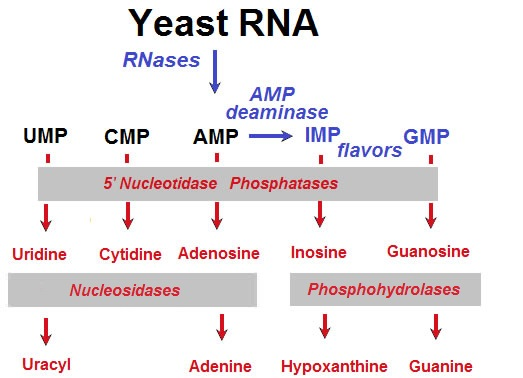
Improve Medium Flavor and Taste: In food fermentation media, nucleic acids undergo enzymatic hydrolysis to produce various flavor nucleotides, such as inosinic acid, guanylic acid, and adenylic acid, imparting a unique umami and rich flavor to the medium. This distinctive flavor enhances the taste and mouthfeel of fermented foods, boosting product market competitiveness. For instance, in酱油 (soy sauce),醋 (vinegar), and fermented beverages, it increases product umami and richness, improving overall quality.
Product Advantages:
High-Purity RNA, Precise Nutrition Supply: RNA content is precisely controlled at two core levels: 30% and 45%. The product features high purity and low impurities (with minimal protein and polysaccharide residues). It directly provides microorganisms with nucleic acid synthesis precursors, reducing their metabolic burden in nucleic acid production, accelerating growth, reproduction, and metabolite synthesis, and enhancing fermentation conversion rates.
Synergistic Nutrient System, Doubles Fermentation Efficiency: In addition to core RNA, the product contains yeast-derived small molecular peptides, free amino acids (such as glutamic acid and aspartic acid), and B-group vitamins, which synergistically with RNA provide microorganisms with comprehensive nitrogen sources, carbon sources, and growth factors. This addresses issues arising from single nutrient sources, such as prolonged fermentation cycles and low product yields. When used alongside yeast extract, peptone, or corn steep liquor as nitrogen sources, it further optimizes nutrient ratios and improves fermentation outcomes. Combined with inorganic salts like phosphates and magnesium sulfate, it balances microbial metabolic environments, enhancing fermentation stability.
Stable Process, Controllable Fermentation Performance: Standardized biological extraction and purification processes ensure minimal batch-to-batch variation in product purity and nutrient content, guaranteeing fermentation process stability and repeatability. The product withstands 121°C high-pressure steam sterilization for 30 minutes, with ≥90% retention of active RNA components. It exhibits excellent water solubility, easily mixes uniformly with other medium components (such as glucose and inorganic salts), and avoids precipitation or clumping, facilitating industrial-scale fermentation production operations.
Product Applications:
Nucleic Acid-Deficient Strains: Strains with nucleic acid deficiencies (such as uridine/uracil-deficient or adenine-deficient types) lack key pathways for independent nucleic acid synthesis and require exogenous nucleic acid supplementation in media for normal growth and reproduction. Yeast ribonucleic acid serves as a core nutritional supplement for such fermentations. Its degradation products—nucleotides and nucleosides—provide nucleic acid synthesis precursors for deficient strains,解除 growth and metabolic constraints, guide metabolic flux toward efficient accumulation of target products, and optimize fermentation system stability. It precisely compensates for nutritional deficiencies, while synergistic nutrients further enhance fermentation efficiency.
Fermentation Industry and Microbial Cultivation Fields:
Industrial Fermentation Media: Rich in amino acids and nucleic acids, it serves as a raw material for肌苷酸 (inosinic acid),鸟苷酸 (guanylic acid), and high-end amino acid fermentation.
Bacterial Culture: Essential for cultivating bacteria such as Escherichia coli and Bacillus subtilis. High-nucleic acid yeast extract provides abundant nitrogen sources and nucleic acids, promoting rapid bacterial growth and reproduction, increasing yield and activity, and commonly used in antibiotic and enzyme preparation production.
Fungal Culture: Critically important for yeast and mold cultivation. For example, in yeast fermentation for alcohol or beer production, it provides comprehensive nutrition to yeast cells, enhancing fermentation efficiency and product quality. In mold culture, it supports production of fungal polysaccharides and organic acids.
Biopharmaceutical Field:
Vaccine Production: Used in cultivating microorganisms or cells for vaccine production. In influenza vaccine production, it provides essential nutrients for host cells, supporting cell proliferation and virus replication, ensuring vaccine yield and quality.
Genetic Engineering Drug Production: When using genetically engineered bacteria to produce protein drugs (such as insulin and growth hormone), it meets the demands for rapid growth and high-efficiency expression of target proteins, increasing drug protein expression and activity.
Food Fermentation Field:
Condiment Production Raw Material: During enzymatic hydrolysis, nucleic acids produce flavor nucleotides, enhancing flavor and nutritional value. It serves as a natural high-I+G extract and a premium raw material for肌苷酸 (inosinic acid) and鸟苷酸 (guanylic acid) fermentation.
Soy Sauce Brewing: Provides nutrition to microorganisms like Aspergillus oryzae, promoting growth and metabolism, generating abundant enzymes, accelerating protein and starch breakdown, improving soy sauce umami and flavor, and increasing amino acid nitrogen content.
Fermented Dairy Products: In yogurt and cheese production, it supports growth and reproduction of lactic acid bacteria and other probiotics, regulates fermentation, enhances product taste and flavor, and boosts nutritional value.
Biological Pesticides and Biofertilizers Field:
Plant Nutrition Field: Suitable for fermenting biological pesticide strains such as Bacillus thuringiensis and Bacillus subtilis, as well as biofertilizer strains like nitrogen-fixing and phosphate-solubilizing bacteria. It promotes rapid microbial proliferation, enhances activity and stability, and ensures application effectiveness of biological pesticides and fertilizers.
Product Specifications:
Test Item Y-RNA-30 Y-RNA-45
Ribonucleic Acid ≥30% ≥45%
Protein Content ≤25% ≤18%
Moisture ≤8% ≤8%
Ash ≤20% ≤20%
pH 5.0-7.0 5.0-7.0
Usage Recommendations:
Addition Method: Can be directly pre-mixed with glucose, sucrose, inorganic salts, yeast extract, and other medium components for uniform use.
Addition Reference: Adjust based on fermentation strain, product type, and process.常规添加比例 (常规 addition ratio): 0.5%-5.0%.其中 (其中):
常规发酵 (常规 fermentation, e.g., amino acids, organic acids): 0.5%-2.0% (Y-RNA-30更适配 (more suitable for Y-RNA-30)).
高端发酵 (high-end fermentation, e.g., antibiotics, enzyme preparations): 2.0%-5.0% (Y-RNA-45更适配 (more suitable for Y-RNA-45)).
核酸缺陷型发酵 (nucleic acid-deficient fermentation): 2.5%-5.0% (优先选用 Y-RNA-45高纯度规格 (优先选择 Y-RNA-45 high-purity grade)).具体添加量 (specific addition amount) can be optimized based on nutritional gaps of deficient strains and pilot test results.
Product Packaging: 20 kg/bag.
Storage Recommendations: Store in a cool, dry place, protect against moisture.
Shelf Life: 18 months from production date in unopened condition.
We leverage our professional yeast deep-processing technology platform, focusing on precise nutritional research for fermentation media raw materials. We can customize yeast ribonucleic acid products with tailored RNA content, impurity levels, and other specifications based on customers' specific fermentation strains, product requirements, and process conditions. With a rigorous quality control system, stable batch consistency, and a dedicated technical service team, we provide efficient and safe nutritional solutions for biological fermentation enterprises, helping enhance fermentation efficiency and product competitiveness. Welcome to inquire and collaborate, driving high-quality development in the biological fermentation industry!